Conflict minerals: still a long road for the European Union

img_4144.png

In March 2017, after several years of negotiations and advocacy by civil society organizations, the European Union (EU) finally tackled the problem of conflict minerals by adopting a regulation. Although the step may seem important, it should be remembered that it is only a first step and that additional efforts are still essential to ensure that our consumption no longer finances armed conflicts. img_4144.png

Concrètement, qu’est-ce que cela veut dire ?Ce règlement [1]A regulation is a legal act of the European Union (EU). It is mandatory and directly applicable in all EU member countries. a pour but d’encadrer l’importation au sein de l’UE de quatre minerais précis : l’étain, le tantale (produit à partir du coltan), le tungstène (aussi connu sous le nom de wolframite) et l’or. Ensemble, ces 4 minerais sont surnommés les « 3TG ». Également appelés « minerais de conflits », ils sont considérés comme les plus liés au financement de conflits armés, à la corruption, au blanchiment d’argent et aux violations des droits humains. Pourtant, ils se retrouvent dans de nombreux produits de consommation courante tels que les appareils de haute technologie (high tech : smartphones, tablettes, etc.), les voitures et les bijoux. Ils sont pour ainsi dire omniprésents dans notre vie quotidienne.Selon ces nouvelles règles, les entreprises présentes sur le territoire de l’UE devront, à partir du 1er janvier 2021, mettre en œuvre leur « devoir de diligence [2]This duty of care also corresponds to that provided for in the “OECD Guidance on due diligence for responsible supply chains for minerals from… Continue reading ». Elles devront donc vérifier que les minerais dont elles s’approvisionnent n’ont pas été produits de manière à financer des conflits ou d’autres activités illicites.Concrètement, cela veut dire que les entreprises importatrices devront :
  1. Establish effective information management systems (for example, identify imported minerals and quantities, specify their country of origin, the name and address of their suppliers, etc.);
  2. Assess the risks associated with the supply of minerals, i.e. the likelihood that these raw materials finance conflict, are the product of forced or child labor, etc. ;
  3. React responsibly to manage and remedy identified risks;
  4. Carry out an independent audit conducted by third parties;
  5. Publish a report each year on the exercise of their duty.
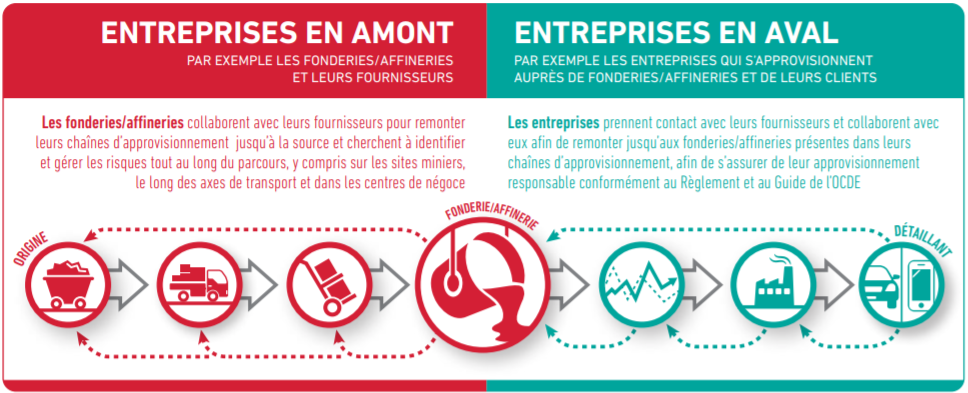
Des règles trop peu ambitieusesSi la société civile belge et européenne a accueilli positivement cette première étape législative pour laquelle elle a plaidé pendant de nombreuses années, elle regrette toutefois que le texte final ne soit pas aussi ambitieux que celui initialement proposé par le Parlement européen. De nombreuses concessions ont en effet été faites aux entreprises au cours des négociations, vidant progressivement la loi de sa substance [3]See also, Justice and Peace, EU and conflict minerals: 2021 deadline, May 2017. .Justice et Paix déplore par exemple le fait que le règlement ne couvre pas l’entièreté des chaînes d’approvisionnement [4]“Mineral supply chain” means all activities, organizations, actors, technologies, information, resources and services involved in the… Continue reading de façon obligatoire mais, au contraire, qu’il prévoit des règles différentes selon l’endroit où les entreprises se situent. En effet, seules les entreprises « en amont », c’est-à-dire celles qui extraient, fondent et affinent les minerais, doivent obligatoirement mettre en œuvre leur devoir de diligence. Celles « en aval », qui transforment les métaux en produits finis et les vendent aux consommateurs finaux, n’y sont tenues que si elles importent des produits au stade de métaux. Les entreprises en fin de chaîne qui importent des produits finis, tels que des téléphones portables, ne sont finalement contraintes à aucune obligation en vertu du règlement, même en présence de ces minerais problématiques. On espère simplement qu’elles usent d’outils d’information pour renforcer la transparence de leur devoir de diligence.L’Union européenne est très dépendante de l’importation d’un grand nombre de matières premières. Elle l’est par exemple à 100% pour le tantale, considéré comme une matière première critique pour l’UE [5]European Commission, Communication from the Commission to the European Parliament, the Council, the European Economic and Social Committee and the Committee of the Regions on the 2017 list of … Continue reading. But ultimately, given that the majority of imports into the EU consist of minerals already processed and assembled in factories in Asia, the regulation will affect only a few companies (only 450 according to estimates). [6]Justice and Peace, jQuery('#footnote_plugin_tooltip_16337_1_6').tooltip({tip:'#footnote_plugin_tooltip_text_16337_1_6',tipClass:'footnote_tooltip',effect:'fade',predelay:0,fadeInSpeed:200,delay:400,fadeOutSpeed:200,position:'top center',relative:!0,offset:[-7,0],}), pour toute l’Union européenne).De plus, d’autres éléments techniques restreignent encore davantage le champ d’application de cette loi. Il existe par exemple des seuils d’importation en dessous desquels aucune obligation n’est prévue, ainsi qu’une « liste blanche » des fonderies et affineries mondiales qui – théoriquement – s’approvisionneraient de façon responsable. L’impact réel sur le terrain et pour les populations affectées par les conflits risque donc finalement d’être minime.Enfin, les ONG regrettent amèrement que le règlement s’attaque uniquement à ces quatre minerais, alors qu’il est prouvé que d’autres sont tout autant problématiques et méritent également l’attention des responsables politiques. Pour n’en citer que quelques-uns, on peut par exemple penser au cuivre, au cobalt et aux diamants [7]On the subject of diamonds, see the Justice and Peace study “Blood diamonds, what responsibility for Belgium? », June 2019. . Ceux-ci sont aujourd’hui très peu contrôlés, alors qu’ils sont tout autant présents dans notre environnement quotidien (voitures, batteries électriques équipements industriels…).Ainsi, aux yeux de la société civile, l’UE a raté une occasion unique de s’engager véritablement pour la défense des droits humains. Et d’ici 2021 ?Bien que le règlement ne prendra totalement effet qu’à partir du 1er janvier 2021, certaines mesures doivent et ont déjà être prises.La Commission européenne a par exemple mis en place un certain nombre de critères pour certifier des mécanismes de devoir de diligence [8]Commission Delegated Regulation 2019/429 of 11 January 2019 supplementing Regulation (EU) 2017/821 of the European Parliament and of the Council as regards the methodology and criteria to… Continue reading. These would make it possible to certify that these voluntary responsible sourcing initiatives, to which companies can adhere, pursue the same objectives as the regulation or similar objectives. In this regard, let us remember that simply joining such a voluntary mechanism cannot in any case be sufficient. On the contrary, it is proven that, despite adherence to such a mechanism, the effective application of the duty of care is not guaranteed [9]See for example Assessment of Alignment of Industry Programs with OECD Minerals Guidance, 2018.. La Commission européenne devrait donc aller plus loin et s’assurer que les entreprises qui adhèrent à de tels mécanismes mettent réellement en pratique leurs devoirs, notamment par le biais d’évaluations et de contrôles réguliers. Comme cela a déjà été le cas par le passé, les entreprises risquent sinon de tirer profit de l’image positive d’une telle adhésion sans pour autant prendre les mesures nécessaires.Les États membres de l’UE restent quant à eux responsables de l’application effective du règlement. Ils doivent ainsi nommer une autorité compétente pour l’application des règles (en Belgique il s’agit du SPF Économie), établir et rendre publique la liste des entreprises nationales importatrices, puis, à partir de 2021, effectuer des contrôles pour s’assurer que les importateurs respectent leurs obligations. Les services douaniers de plusieurs États membres, y compris belges, ont cependant d’ores et déjà exprimé des réticences à une telle divulgation de données, invoquant une clause de confidentialité du Code des douanes de l’Union (CDU). La société civile rappelle que le même code prévoit une dérogation en cas d’obligation légale, telle que celle prévue par le règlement [10]For more information on this and on assessing the implementation of the Regulation, see the Joint Policy Note, Ensuring the proper implementation of the EU Regulation on… Continue reading. Qui plus est, la transparence est la clé de voûte du règlement et, plus globalement, du devoir de diligence. Il en va donc de l’efficacité et de la crédibilité même du règlement que ces listes soient rendues publiques.Enfin, pour l’instant aucune sanction pour non-conformité n’est prévue. Selon le règlement, ce sont les États membres qui fixent les règles applicables aux violations. Il est donc crucial que les autorités nationales compétentes prévoient dès maintenant des mesures appropriées en cas de manquement des entreprises et qu’elles en assurent le suivi. Aller au-delà du règlement, un engagement nécessaireLe règlement prévoit que le 1er janvier 2023 au plus tard, puis tous les trois ans, la Commission européenne réexamine le fonctionnement et l’efficacité de ce nouveau système. Si nécessaire, elle pourra proposer de nouvelles mesures afin de garantir une chaîne d’approvisionnement des minerais responsable. La société civile a déjà de nombreuses recommandations et pistes d’amélioration qu’elle proposera.En attendant, et compte tenu des limites inhérentes de ce règlement, il est important que l’Union européenne et ses États membres prennent des mesures supplémentaires pour résoudre d’autres problèmes, notamment de développement et de gouvernance dans le secteur minier. A ce titre, l’UE s’est engagée en 2014 à prendre une série de « mesures d’accompagnement [11]Joint communication from the Commission and the High Representative of the Union for Foreign Affairs and Security Policy, For an integrated approach at … Continue reading » in order to improve the effectiveness of the regulation and to dedicate 20 million euros to it. These mainly involve incentive measures for the private sector, political dialogue with third countries and development cooperation. Unfortunately, most of the measures taken so far suffer from several shortcomings [12]For an analysis of the proposed measures, see EurAc, Accompanying measures to the EU Regulation on responsible sourcing of minerals, March 2017..Afin de donner la parole à la société civile des pays producteurs et d’obtenir leurs points de vue sur les risques, opportunités et défis liés au règlement et ses mesures d’accompagnement, Justice et Paix et son partenaire européen EurAc [13]European Network for Central Africa. organized a workshop on April 29 and 30 in Brussels with members of Congolese and Colombian civil society. This made it possible to develop several recommendations for the attention of Belgian and European political decision-makers in order to improve the effectiveness of these new rules and their impact on the ground. [14]A full report of these discussions and recommendations will be published soon..In the specific context of the Democratic Republic of Congo, the country with which Justice and Peace works, it is, for example, urgent to strengthen the governance of the artisanal mining sector. This necessarily involves formalizing the sector and improving conditions for artisanal mining (which would concern around 2 million diggers), for example through:
  • Access for artisanal workers to secure mining zones (the legislation on artisanal mining zones (ZEA) already offers this possibility, but its implementation remains incomplete);
  • Technical and financial support for artisanal miners and local communities so that they can create and manage cooperatives [15]On the issue of mining cooperatives, see EurAc, Accompanying measures to the EU Regulation on responsible mineral sourcing, For strengthening the governance of… Continue reading (for the moment, in reality, it is rather the elites who often benefit from cooperatives), access to credits and microcredits;
  • Strengthening the capacities of Congolese state authorities and administrations, in particular the Small Scale Mining Assistance and Supervision Services (SAESSCAM) and the Mines Division;
  • A more equitable distribution of certification and audit costs between artisanal diggers, intermediaries, and the downstream sector (certification costs currently fall disproportionately on artisanal diggers);
  • More direct cooperation between downstream companies and craft cooperatives to implement due diligence and shorten the supply chain;
  • Support and protection of Congolese civil society, particularly in its advocacy and training work;
  • A strengthened political dialogue at the regional level, particularly at the level of the International Conference on the Great Lakes Region (ICGLR), to enable better implementation of the regional certification mechanism, harmonization of taxation, and thus fight against fraud mining to neighboring countries.
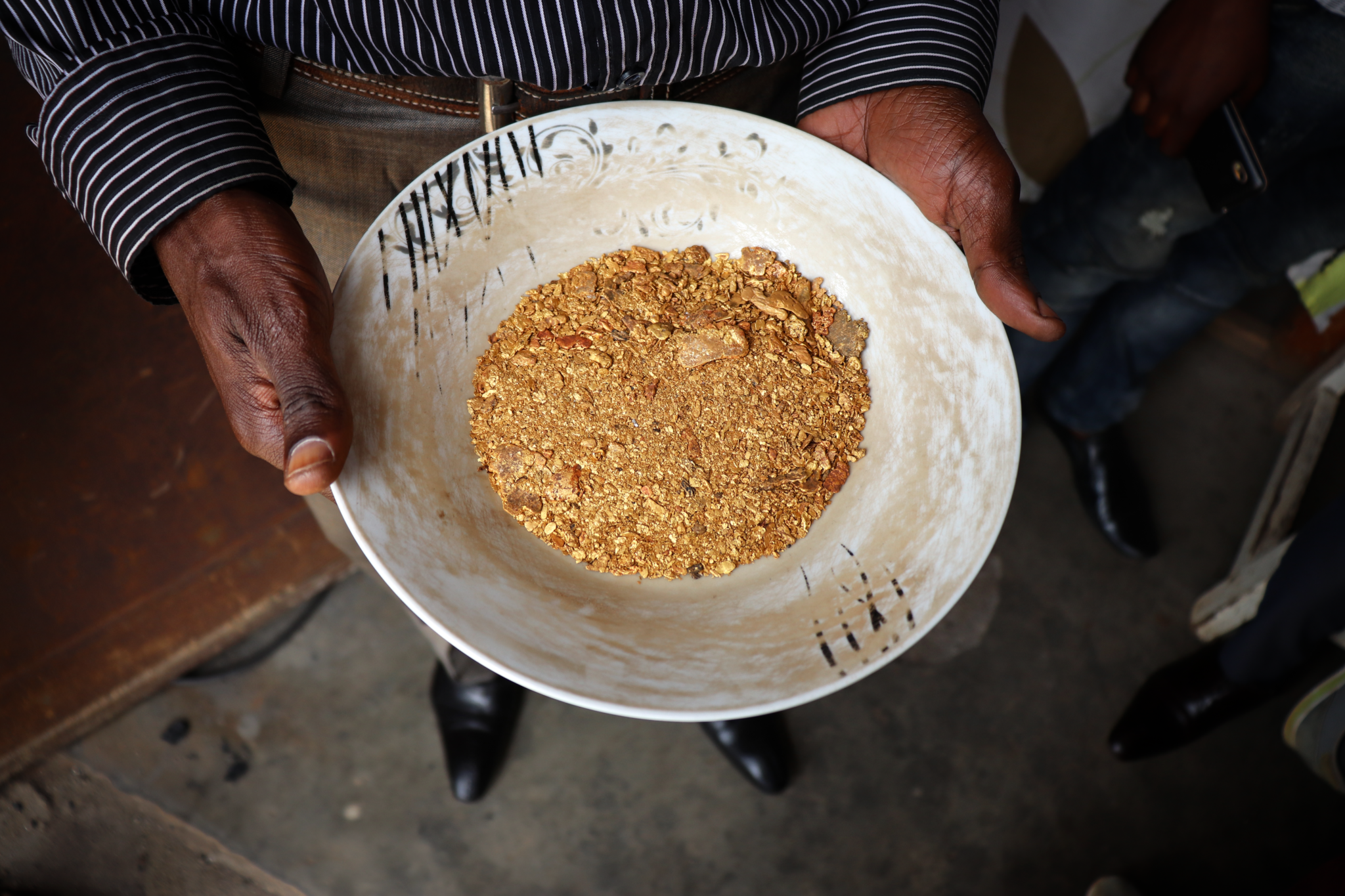
While waiting for these upcoming deadlines, civil society will continue to closely monitor legislative and political developments related to this issue. Change rests largely on politics and business. But also on citizens who, through their choices and consumption, can influence what happens at the other end of the supply chain. Although the human realities experienced by people experiencing conflict and violence in areas rich in natural resources may seem far away and disconnected from what we experience, the objects we use every day and that we hold so dear should remind us that we are ultimately intimately linked to their fate. More than a question of ethics, it is our responsibility. Questioning and changing our consumption patterns remains today the most direct and effective way to move things forward. So let's think twice before buying and throwing away!
Agatha Smyth.

Attachments

Notes

Notes
1A regulation is a legal act of the European Union (EU). It is mandatory and directly applicable in all EU member countries.
2This duty of care corresponds moreover to that provided for in the “ OECD Due Diligence Guidance for Responsible Supply Chains for Minerals from Conflict and High-Risk Areas » which, in certain parts, also addresses 3TG. Although it represents the reference text on the subject, the OECD guide remains voluntary, therefore subject to the goodwill of companies. The EU regulation is theoretically binding, that is to say obligatory.
3See also, Justice and Peace, EU and conflict minerals: 2021 deadline, May 2017.
4“Mineral supply chain” means all activities, organizations, actors, technologies, information, resources and services involved in the transport and processing of minerals from the extraction site to their incorporation into the finished product.
5European Commission, Communication from the Commission to the European Parliament, the Council, the European Economic and Social Committee and the Committee of the Regions on the 2017 list of critical raw materials for the EU, COM(2017) 490 final, 13.9.2017.
6Justice and Peace, 7On the subject of diamonds, see the Justice and Peace study “Blood diamonds, what responsibility for Belgium? », June 2019.
8Commission Delegated Regulation 2019/429 of 11 January 2019 supplementing Regulation (EU) 2017/821 of the European Parliament and of the Council as regards the methodology and criteria to be used for the assessment and certification of duty of care mechanisms supply chain diligence for tin, tantalum, tungsten and gold.
9See for example Assessment of Alignment of Industry Programs with OECD Minerals Guidance, 2018.
10For more information on this and on the evaluation of the implementation of the Regulation, see the Joint Policy Note, Ensuring the proper implementation of the EU Regulation on the responsible sourcing of minerals from conflict or high-risk areas, April 24, 2019.
11Joint communication from the Commission and the High Representative of the Union for Foreign Affairs and Security Policy, For an integrated approach at Union level to the responsible sourcing of minerals from conflict or high-risk areas, March 5, 2014.
12For an analysis of the proposed measures, see EurAc, Accompanying measures to the EU Regulation on responsible sourcing of minerals, March 2017.
13European Network for Central Africa.
14A full report of these discussions and recommendations will be published soon.
15On the issue of mining cooperatives, see EurAc, Accompanying measures to the EU Regulation on responsible mineral sourcing, To strengthen the governance of the artisanal mining sector in the DRC, March 2017, p.13-16.
Facebook
Twitter
LinkedIn
Print
E-mail

In the news

Stay informed

Subscribe to our online newsletter and receive complete monthly information.

Get involved with us!

Our queer news in your inbox?

Complete this form to be kept up to date with our educational news (training, educational tools, etc.)

Firstname name
Je souhaite m'inscrire à la newsletter "Pédagogie" de Justice & Paix